
Cedars Point Kennel: Building a Data-Driven Small Munsterlander Breeding Program

Updated: Apr 14
From Foundation Dogs to a Breed Intelligence System
Breeding Small Munsterlanders is not a straight line. It’s a long-term process shaped by what works, what fails, and what you learn along the way.
Over the past seven years, we’ve worked with three foundational females—Aster, Soda, and Yetta—and multiple sires. Some pairings exceeded expectations. Others didn’t.
What changed over time wasn’t just the dogs—it was how we measured them.
This program is built around one idea:
If you don’t track outcomes, you’re guessing which is central to how we think about how to choose a Small Munsterlander breeder.
Before getting into the program itself, it’s important to be clear about who this is built for.
Who This Is For
This program is not built for everyone.
It is designed for breeders who are:
Actively producing litters and retaining long-term interest in their progeny
Participating in NAVHDA testing (NA, UT, Invitational) or equivalent performance evaluation
Tracking health data beyond basic clearances (hips, longevity, defects, outcomes over time)
Willing to evaluate their own dogs honestly — including weaknesses
Interested in long-term genetic direction, not just individual litter outcomes
The Foundation of the Program-Three Females, Three Different Lessons
Aster → limited production, structural flags in teeth, brood bitch issues
Soda → health signals (hernia pattern, case study)
Yetta → primary data driver
No breeding program goes exactly as planned. What matters is whether you learn from what happens.
Each shaped this program differently.
Aster — When Biology Changes the Plan
Aster was the pick of Cedar’s first litter. She should have been a cornerstone.
Instead:
bred four times
produced one litter
Not due to poor decisions—just the biology of an inhospitable uterus
This is breeding reality.
Soda — When Patterns Demand Attention
Soda became a case study in why tracking matters.
We began with a:
hernia
late hernias and cryptorchidism
repeating concern increasing in presentation
Individually explainable. Together? A pattern.
This is where data matters most. Not just data on the bitch either.
🔗 Read more: Progressive Heritable Conditions Case Study (Soda)
Yetta — When Consistency Emerges
Yetta gave us something different:
Repeatability
Across litters and sires:
strong NAVHDA outcomes and participation
strong performance beyond NA
Repeated and consistent sensory load and nerve stability
Not just standout dogs—predictable litters
Why Performance Data Matters (Beyond Pedigree)
Breeding decisions are often made on pedigree and individual performance. That has value—but it’s incomplete.
What matters is:
what a dog produces
how those dogs develop
whether those outcomes repeat
NAVHDA provides a structured way to evaluate that progression:
Gun Dog (GDT) → intermediate performance
Utility (UT) → finished dog standard
NA tells you what a dog starts with.
Utility tells you what holds together.
Chart 1 —Natural Ability Distribution (A–G Litters)
This chart shows the overall performance outcomes of a litter so breeders can evaluate what the pairing actually produced—not just individual standout dogs.

What this chart shows
Distribution of NA scores across litters A–G.
Key observations
Consistency across repeated Yetta × Cedar pairings
Variability in out-crosses
Strong top-end (108–112) concentration in specific crosses
Takeaway
NA shows early potential—but it does not tell you how that potential holds up over time.
Chart 2 — Advanced Testing (Gun Dog & Utility)
This chart shows Gun Dog and Utility-level NAVHDA performance across select progeny, making clear both how these pairings perform at advanced levels and how few dogs are actually developed beyond Natural Ability.

Dogs with multiple entries reflect repeat advanced testing attempts.
What this chart shows
Across the A–G litters, 40 dogs entered NAVHDA Natural Ability testing, but only five progressed beyond NA into Gun Dog or Utility-level work. This chart shows that advanced subset.
While the group is small, it represents the point where development, opportunity, and the dog’s ability to hold up under more demanding work begin to separate more clearly. Outcomes at this level are not uniform, but they provide a clearer view of how dogs perform beyond early entry-level testing.
This is where we start to see how these dogs perform at higher levels, as reflected in our broader testing and performance outcomes.
Key observations
Not all NA dogs advance test
Advanced scores begin to help separate pairings
Utility-level dogs are limited but highly informative
Why this matters
Gun Dog and Utility testing reflect:
training tolerance
mental stability
durability under pressure
These are the traits breeders need to evaluate breeding stock—not just early performance.
Chart 3 — Follow-Through Funnel (A–I Litters)
What breeders produce and what buyers carry forward are not separate issues. The follow-through funnel below is where those two realities meet.

What this chart shows
Progression from:
pups born
→ NA tested
→ NA prized
→ advanced testing
H and I litters are included as upcoming cohorts scheduled for testing.
Key observations
Drop-off between born → tested varies by litter
Strong litters still require buyer follow-through
Advanced testing is the narrowest point in the pipeline
What this means in practice
Breeding outcomes are not created at whelping.
They are created through:
placement
training
testing
and reporting back
A litter only becomes valuable to a breeder when it produces usable information.
The Missing Piece: Buyer Participation
Buyers are not separate from the breeding program.
They determine whether:
dogs are trained
dogs are tested
data is returned
A well-placed dog becomes:
a hunting companion
and a data point
a decision making tool
Without that follow-through, even strong litters produce limited insight.
This is one of the hardest variables to control, even with the structure we try to build through our buyer process.
And this isn’t unique to one kennel.
Why This Matters Beyond One Kennel
What’s shown here is not unique to Cedars Point.
Across the breed, most data stops at Natural Ability. Even among engaged breeders, relatively few dogs are developed to the Gun Dog and Utility levels, and fewer still are tracked in a way that connects outcomes back to specific pairings.
That creates a gap.
Breeding decisions are often made using:
individual standout dogs
limited test results
incomplete follow-through across litters
What’s largely missing is a clear picture of:
how entire litters perform
how consistently traits carry forward
how many dogs are actually developed far enough to reveal meaningful signal
Without that, it becomes difficult to distinguish:
true consistency from isolated success
strong pairings from one-off outcomes
early promise from finished ability
This isn’t a criticism of individual breeders — it’s a limitation of the system most of us are working within.
The goal of this program is to make those patterns visible, so breeding decisions can be grounded in complete, longitudinal data rather than partial snapshots.
Connecting Early Data to Long-Term Outcomes
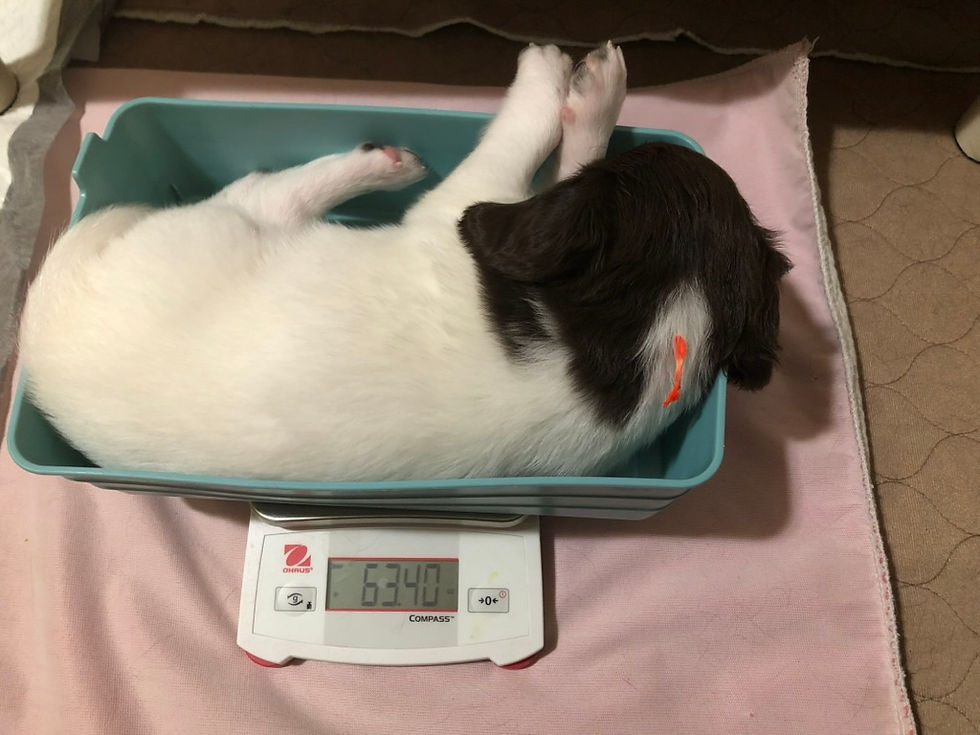
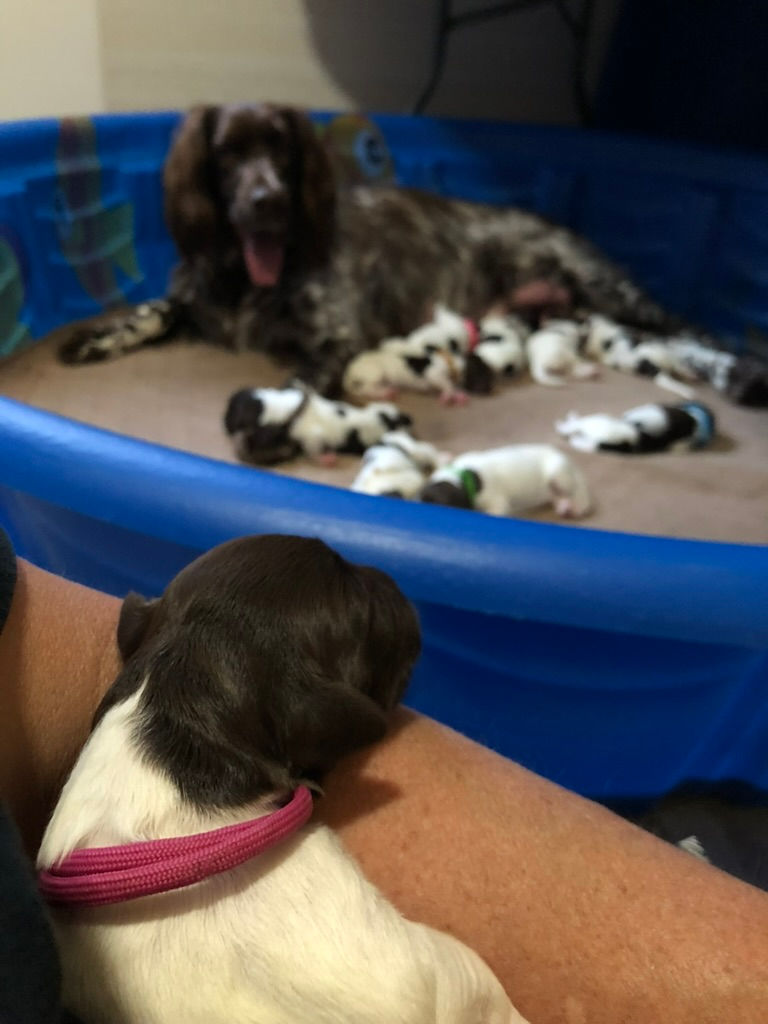
We track early litter development through what we call the Puppy Litter Data Sheet (PLDS)—a structured system that records birth weight, Q coefficient, daily weights through day 16, growth curves through week 7, Early Neurological Stimulation (ENS), temperament observations, and Volhard Puppy Aptitude results.
We track:
birth weight
Q co-efficient
early growth curves
passive puppy observation
temperament testing (Volhard PAT)
overall litter health and development
opportunity-did dogs get tested
And we compare that to:
NAVHDA performance
long-term outcomes
The goal is not just evaluation it's to start connecting with long-term outcomes, which begins with how we approach early evaluation and temperament.
The goal is correlation-Breeder Intelligence:
do early indicators actually predict performance
what patterns repeat across litters
Early development is something we’ve written about in detail, including:
What the Data Is Beginning to Show
What’s emerging is not a definitive answer—but it is direction.
Early developmental data—captured through structured observation like the Volhard Puppy Aptitude Test and early litter metrics—appears to align, at least in part, with how dogs progress when given the opportunity.
Dogs that move on to advanced testing tend to show:
lower sensory load (better regulation)
stronger nerve stability
consistent, moderate responses rather than extremes
At the same time, a large portion of dogs are never developed far enough to confirm what those early signals may have indicated.
This creates a gap.
Not a gap in ability—but a gap in follow-through.
And that gap matters more than anything else in the system.
Chart 4 — Volhard-Derived Sensory Load, Nerve Stability, and Testing Outcomes
When early developmental traits from the Puppy Litter Data Sheet are viewed alongside real testing outcomes, a pattern begins to emerge—not as a conclusion, but as direction.

Based on litters with complete early development and outcome data.
One of the more unexpected observations is that placement decisions—made before any formal model existed—appear to align with early developmental sensory load and nerve stability.
Dogs placed in less development-focused homes tended to show higher sensory load and lower nerve stability, while dogs that progressed further were, on average, easier to develop.
This does not suggest certainty—but it does suggest that intuitive placement decisions may already be picking up on patterns that structured data can now begin to define.
At the same time, a significant portion of dogs are never developed far enough to determine whether those early traits would have held.
This is where the system breaks—not in the dog, but in the follow-through.
What This Means for Breeding Decisions
If that pattern holds, even loosely, it changes how we think about selection and placement.
This isn’t about predicting outcomes with certainty.
It’s about improving the odds—and reducing the guesswork.
If early developmental patterns continue to hold as more data is collected, breeders can begin to:
make more informed retention decisions
better match puppies to homes that will develop them
recognize which traits are worth selecting for—and which ones quietly limit progress
But none of that works without participation.
Because without participation, there is no dataset.
Why This Requires More Than One Kennel
No single breeder—no matter how structured—can generate enough data to move a breed forward alone.
Not in temperament.
Not in performance.
Not in structure.
Not in health.
The system only becomes meaningful when:
breeders contribute data across litters
buyers follow through on development
outcomes are tracked honestly, not selectively
That’s when patterns begin to stabilize.
That’s when decisions become less subjective.
That’s when we stop guessing.
The Direction Forward
This is where the work becomes intentional.
Our program is at an inflection point continuing with:
retained dogs (Cedars Point I’ve Got Your Number-Briar, Cedars Point Glitzy Spitz and Cedars Point Henous Hydra-River)
the upcoming litter (Cedars Point Glitzy Spitz)
new testing cohorts (H & I litters)
The goal is simple:
Develop and build a system where breeding decisions are based on:
repeatable outcomes
not isolated results
better informed decision making
What This Could Become (If We Choose To Build It)
This doesn’t stop at temperament and testing either.
The same framework can expand to include:
conformation evaluation (IABCA, structural feedback, movement)
health tracking (hernia, dentition, cryptorchidism, longevity health reporting)
coat and type consistency
handler vs breeder development outcomes-where dogs are placed
real-world hunting performance
This is already standard in parts of Europe.
It does not currently exist in the USA in a meaningful, unified way.
But it could.
A Different Way to Think About Breeding
This is not about control. It’s not about marketing. It’s not about one kennel proving something.
It’s about service to the breed.
Kurt Hahn, founder of Outward Bound, believed that:
“There is more in us than we know, and if we can be made to see it, perhaps for the rest of our lives we will be unwilling to settle for less.”

That applies just as much to breeding as it does to people.
There is more in these dogs than we are currently seeing.
Not because the dogs are lacking—but because the system around them is incomplete.
Learn More About Our Program Beliefs (Internal Links)
FAQ
Some of the most common questions that come up when thinking about this approach:
Why not rely on pedigree alone?
Because pedigree does not show what a dog produces consistently.
Why is Utility testing important?
It evaluates finished performance, not just potential.
Why include buyers in the system?
Because without follow-through, there is limited usable data.
Is this system complete?
No. It is a working model that improves as more data is added along with breeder participation and ideas. It's one breeders vision aimed at an alliance of breeders who share in the vision.
How does PLDS help improve breeding decisions?
The PLDS (Puppy Litter Data Sheet) tracks early development—growth, litter stress on dam and her puppy response to it, ENS, passive puppy observations and a 49 day temperament or puppy aptitude test(Volhard PAT).
That data is later correlated to:
NAVHDA performance
health outcomes
and longevity
Over time, this data should help identify patterns between early development and long-term results. Our hope it will help inform retention decisions.
Final Thoughts
Breeding is not linear.
Some pairings exceed expectations.
Some fail.
Most fall somewhere in between.
What matters is not avoiding mistakes.
What matters is building a system that learns from them.
Where This Goes From Here
The goal is simple:
Not more dogs.
Not more noise.
Not more opinions.
Better information.
Shared.
Built over time.
Used to make decisions that actually move the breed forward.

And If There’s One Thing the Data Makes Clear
It’s this:
We don’t need perfect data to begin.
We need participation.
Because once participation is there—clarity follows.
References
The following frameworks and research areas informed the approach outlined above.
North American Versatile Hunting Dog Association — Aims, Programs, and Test Structure
Fédération Cynologique Internationale — Small Munsterlander Breed Standard
Small Munsterlander Club of America — Breed Guidelines and Registration Framework
Carmen L. Battaglia — Early Neurological Stimulation and Puppy Development
William E. Campbell — Puppy Aptitude Testing and Behavioral Evaluation
Quantitative genetics literature on heritability and trait selection in working dogs
Animal breeding principles related to selection, consistency, and longitudinal evaluation
About the Author
Cedars Point Kennel is focused on building a data-driven breeding program for Small

Munsterlanders, centered on tracking real outcomes across entire litters over time.
The program integrates early development data, temperament evaluation, and NAVHDA testing results to better understand consistency, progression, and long-term performance.
This work is grounded in the belief that meaningful breeding decisions require more than individual results — they require visibility into how pairings perform across complete litters and over time.


Intriguing!